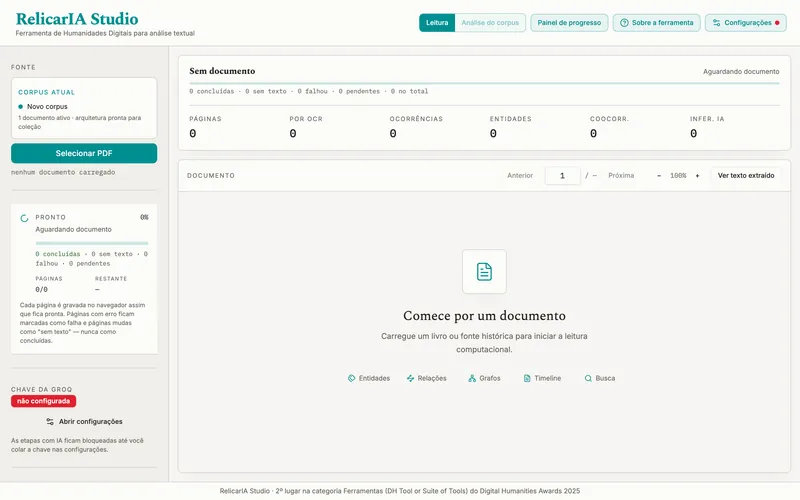
RelicárIA
DH Awards 2025 – 2nd Runner Up, Best DH Tool or Suite of Tools
A platform that combines AI and data analysis to extract and visualize information from historical documents.
Joint work with Danielle Sanches de Almeida (FGV ECMI).
8 projects · 2025–2026
Apps, dashboards, databases and research software I have built, most of them live and open source.
DH Awards 2025 – 2nd Runner Up, Best DH Tool or Suite of Tools
A platform that combines AI and data analysis to extract and visualize information from historical documents.
Joint work with Danielle Sanches de Almeida (FGV ECMI).
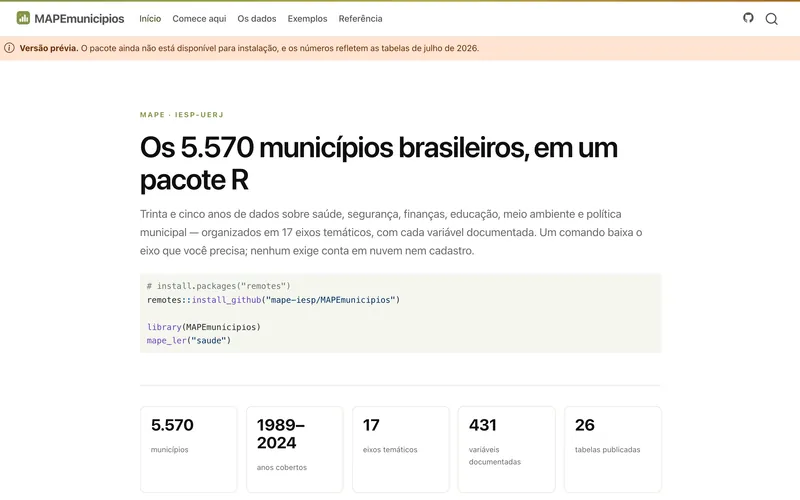
One of the most complete databases on Brazilian municipalities, organized in 17 thematic dimensions and documented as an R package. Made in partnership with researchers at MAPE, with whom I build and maintain the database and its public interface.
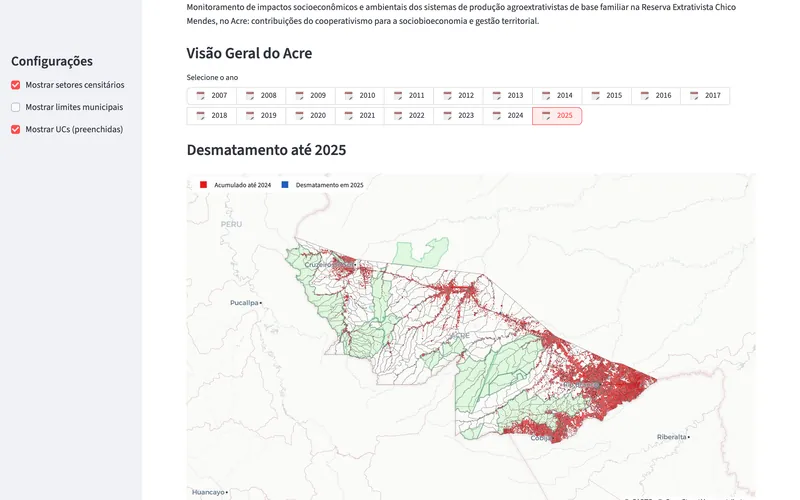
A preliminary version of the RESA project’s public monitoring platform, covering deforestation in Acre.
Maps PRODES/INPE deforestation data for Acre and the Chico Mendes Extractive Reserve, year by year. Part of a study of family-based agroextractive production in the reserve, coordinated by Luci Maria Teston (UFAC).
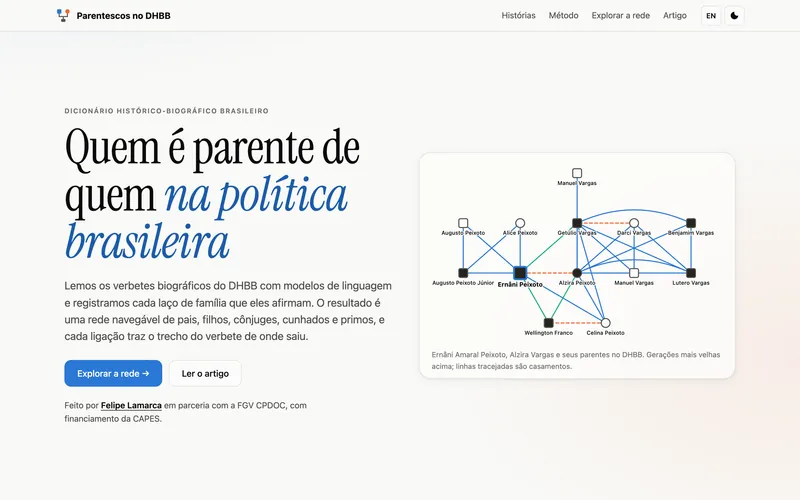
Who is related to whom in Brazilian politics. Language models read the entries of the Dicionário Histórico-Biográfico Brasileiro (DHBB) and record each family tie they state, and every link in the network cites the passage it came from.
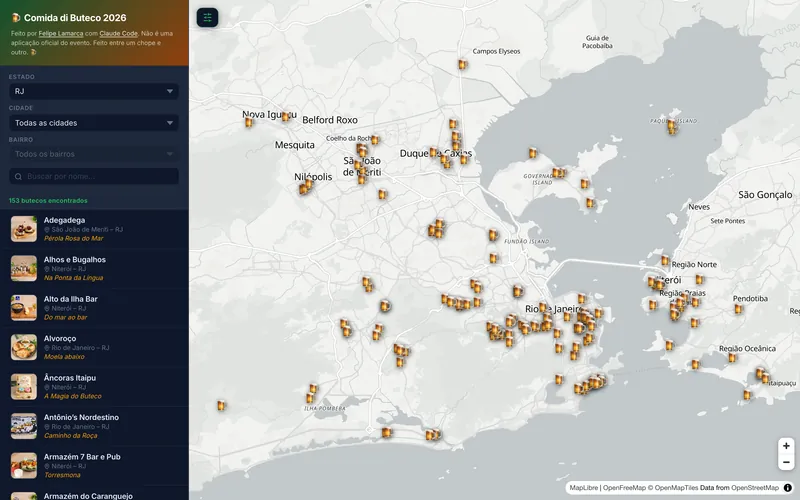
Comida di Buteco is a contest that picks the best bars in cities across Brazil. This project uses web scraping and geolocation to map those bars nationwide.
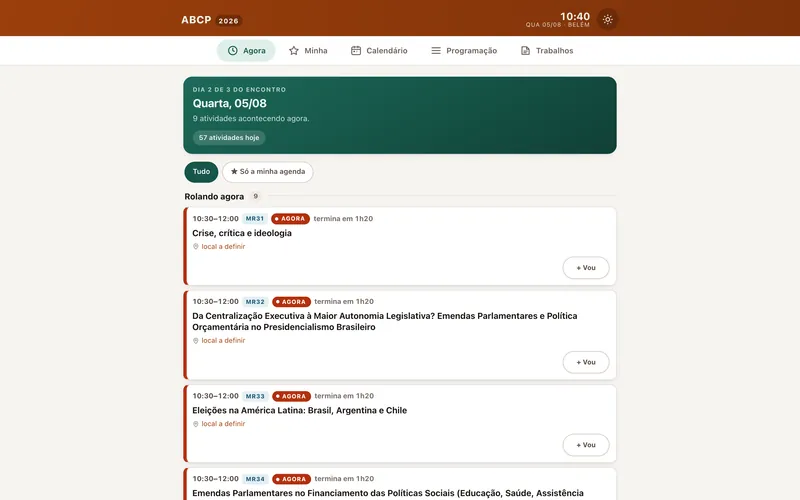
The programme of the 15th ABCP Meeting (Belém, 2026) in real time: what’s on right now, a personal agenda, a calendar, and search across every paper and abstract. What you mark stays on your device.
A Quarto template for IESP-UERJ theses and dissertations.
Joint work with Matheus Cavalcanti Pestana (IESP-UERJ).
A dashboard built on the mape_municipios infrastructure for the office of state deputy Dani Balbi, bringing together MUNIC, PNS, and Censo SUAS data on the LGBTQIA+ population of the state of Rio de Janeiro, including the territorial distribution of social assistance facilities.
Joint work with Tomás Paixão Borges (IESP-UERJ).
Delivered for organizations and research groups; not publicly available.
Digitized and systematized historical election results with OCR and LLMs.
OCR and LLMs applied to the Brazilian Statistical Yearbooks to systematize social assistance data since the early 20th century.
LLM and RAG tools for structured extraction from unstructured documents.
Dashboards in Streamlit and Power BI, and an AWS data lake.
A RAG pipeline for querying FGV researchers’ publications in natural language.
An automated Python pipeline that cut report production from days to about an hour, and interactive maps for corporate audiences.