mapa-da-ciencia
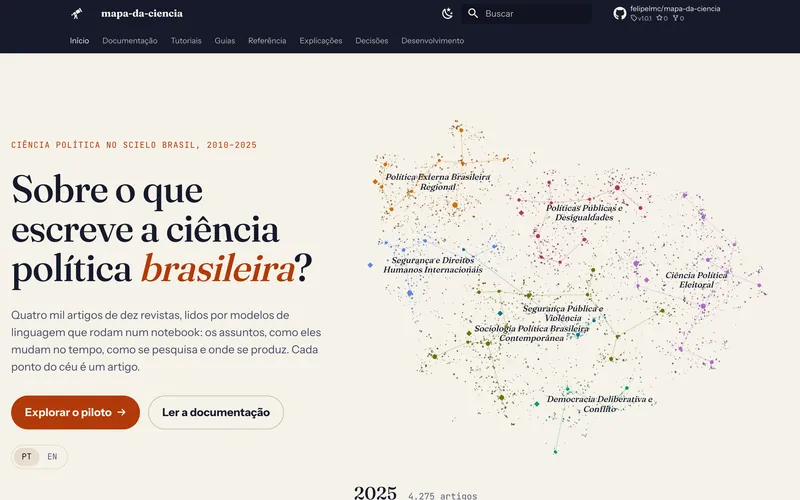
A literature observatory built on local language models: what the literature is about, how research is done and where it is produced. The models run on your own computer through Ollama, so no text leaves your machine.

Computational political science · Rio de Janeiro
Data scientist and social scientist. I study elections, Congress and public opinion in Brazil, and build data and tools for public policy on the Amazon, public security and education.

A literature observatory built on local language models: what the literature is about, how research is done and where it is produced. The models run on your own computer through Ollama, so no text leaves your machine.
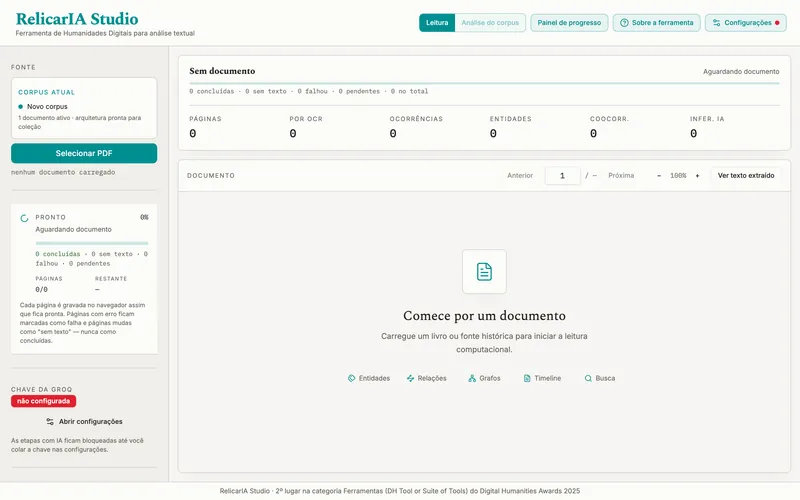
DH Awards 2025 – 2nd Runner Up, Best DH Tool or Suite of Tools
A platform that combines AI and data analysis to extract and visualize information from historical documents.
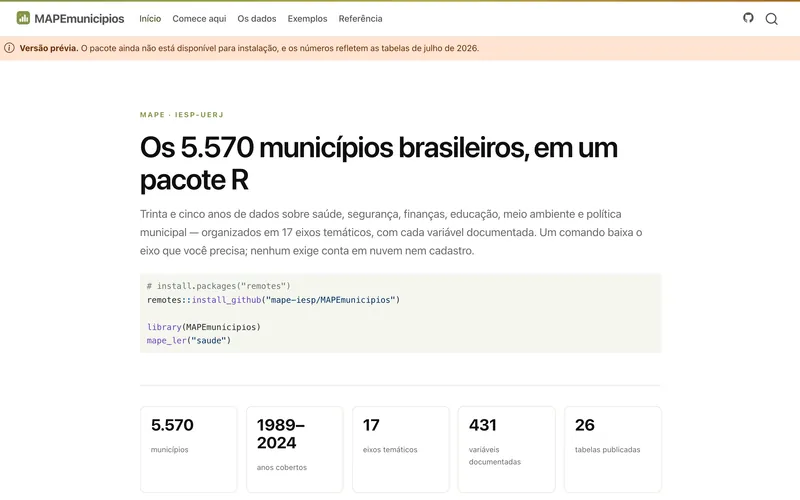
One of the most complete databases on Brazilian municipalities, organized in 17 thematic dimensions and documented as an R package. Made in partnership with researchers at MAPE, with whom I build and maintain the database and its public interface.
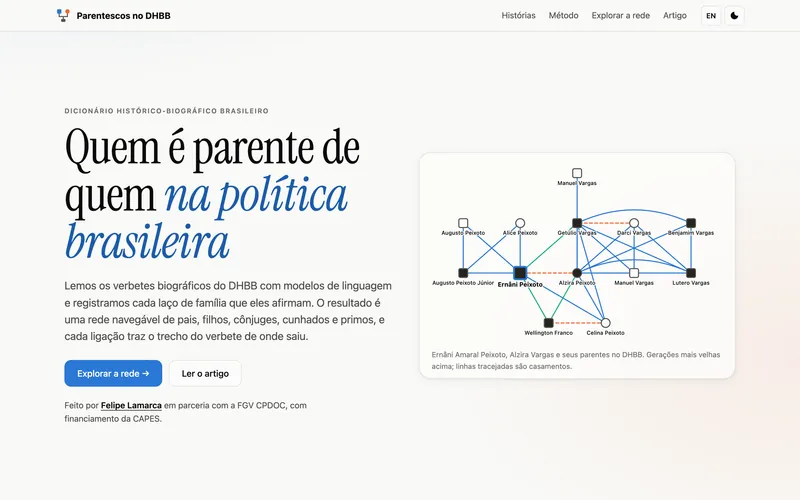
Who is related to whom in Brazilian politics. Language models read the entries of the Dicionário Histórico-Biográfico Brasileiro (DHBB) and record each family tie they state, and every link in the network cites the passage it came from.
M.A. dissertation
M.A. dissertation in progress at IESP-UERJ. Advisor: Fernando Meireles.
Working paper
Joint work with Tomás Paixão Borges (IESP-UERJ).
To be presented at the 50th Annual Meeting of the Brazilian National Association of Graduate Studies and Research in Social Sciences (ANPOCS).
No Brasil, a modelagem estatística é usada no campo de Ciências Sociais quase exclusivamente para explicar fenômenos, raramente para prevê-los. A difusão de técnicas de machine learning, porém, vem dissolvendo a fronteira entre estudos preditivos e causais: a predição serve de benchmark para teorias, revela onde os modelos falham e disciplina o uso da informação disponível. Tendo isto em vista, este manuscrito parte de duas questões. A primeira é substantiva: é possível prever, com boa acurácia, o desempenho eleitoral dos partidos nas eleições proporcionais para vereador usando apenas informação disponível antes do pleito? A segunda é metodológica: como se conduz, na prática, um exercício preditivo rigoroso, dos dados brutos à validação dos resultados? Respondemos com um tutorial reprodutível aplicado aos 92 municípios fluminenses em três eleições (2016, 2020 e 2024), em expansão para o conjunto dos municípios brasileiros.
Working paper
Joint work with Lucas Calabró Berti (IESP-UERJ).
Presented at the 2026 Meeting of the Brazilian Political Science Association (ABCP).
Este trabalho analisa os determinantes da aprovação de pautas na Câmara dos Deputados, com foco em fatores políticos e institucionais que condicionam o sucesso das proposições. A literatura sobre estudos legislativos e presidencialismo destaca como variáveis relevantes organização interna do Legislativo, pork barrel, disciplina partidária, acesso à informação, patronagem e tamanho e coesão da coalizão. Partindo desse debate, o trabalho investiga em que medida esses elementos afetam a probabilidade de aprovação das pautas ao longo do processo decisório. Metodologicamente, o estudo combina análise quantitativa de proposições legislativas e votações nominais com indicadores de coordenação partidária e características institucionais do processo legislativo. Ao articular a literatura de estudos legislativos com a de presidencialismo, argumentamos que a atuação da Câmara Baixa não pode ser compreendida a partir de uma única teoria de organização, mas sim a partir de uma combinação destas.
“Quantos votos meu partido vai fazer?”, joint work with Tomás Paixão Borges, will be presented at the 50th ANPOCS Annual Meeting (SPG 31 — Methodology and Research Methods in the Social Sciences). More
Released mapa-da-ciencia 1.0, an observatory of the scientific literature built on local language models. Its pilot maps 4,275 political science articles from SciELO Brasil, 2010–2025. More
Published a DOXA discussion paper on how the population of the state of Rio de Janeiro gets information about politics, with its replication package. More
Taught a short course on AI agents for social science research (an introduction to Claude Code) at MAPE’s Methodological Training, IESP-UERJ. More
“Da gaveta ao plenário”, joint work with Lucas Calabró Berti, was presented at the XV ABCP Meeting in Belém, Brazil. More
Taught short courses on AI agents for academic research at LABIIA and at CERES (IESP-UERJ). More
Awarded the FAPERJ Nota 10 graduate scholarship for outstanding performance in the first year of the Master’s program at IESP-UERJ.
RelicárIA was 2nd Runner Up for Best DH Tool or Suite of Tools at the DH Awards 2025. More

I'm a data scientist with a degree from the School of Applied Mathematics (FGV EMAp) and a social scientist with a degree from the School of Social Sciences (FGV CPDOC). Currently, I'm pursuing a Master's degree in Political Science at the Institute of Social and Political Studies (IESP-UERJ).
I work as a data scientist at AtlasIntel, where I calibrate election polls in Brazil and abroad, and do research at three laboratories: the Policy and Election Monitoring and Evaluation Laboratory (MAPE), the Laboratory of Electoral Studies, Political Communication and Public Opinion (DOXA), and the Center for Studies on Congress (NECON).
I also coordinate the quantitative analysis of the RESA project, on what agroextractive cooperatives change in household income and deforestation in Acre, and work on a systematic review of public security policies for the Legal Amazon, with a Pensando o Direito grant from the Ministry of Justice.
My research interests include political behavior, public policy, and the application of data science techniques to social science research. This broadly encompasses the use of machine learning, deep learning, causal inference, and survey methods to investigate political phenomena.
Email: felipe.lamarca@hotmail.com